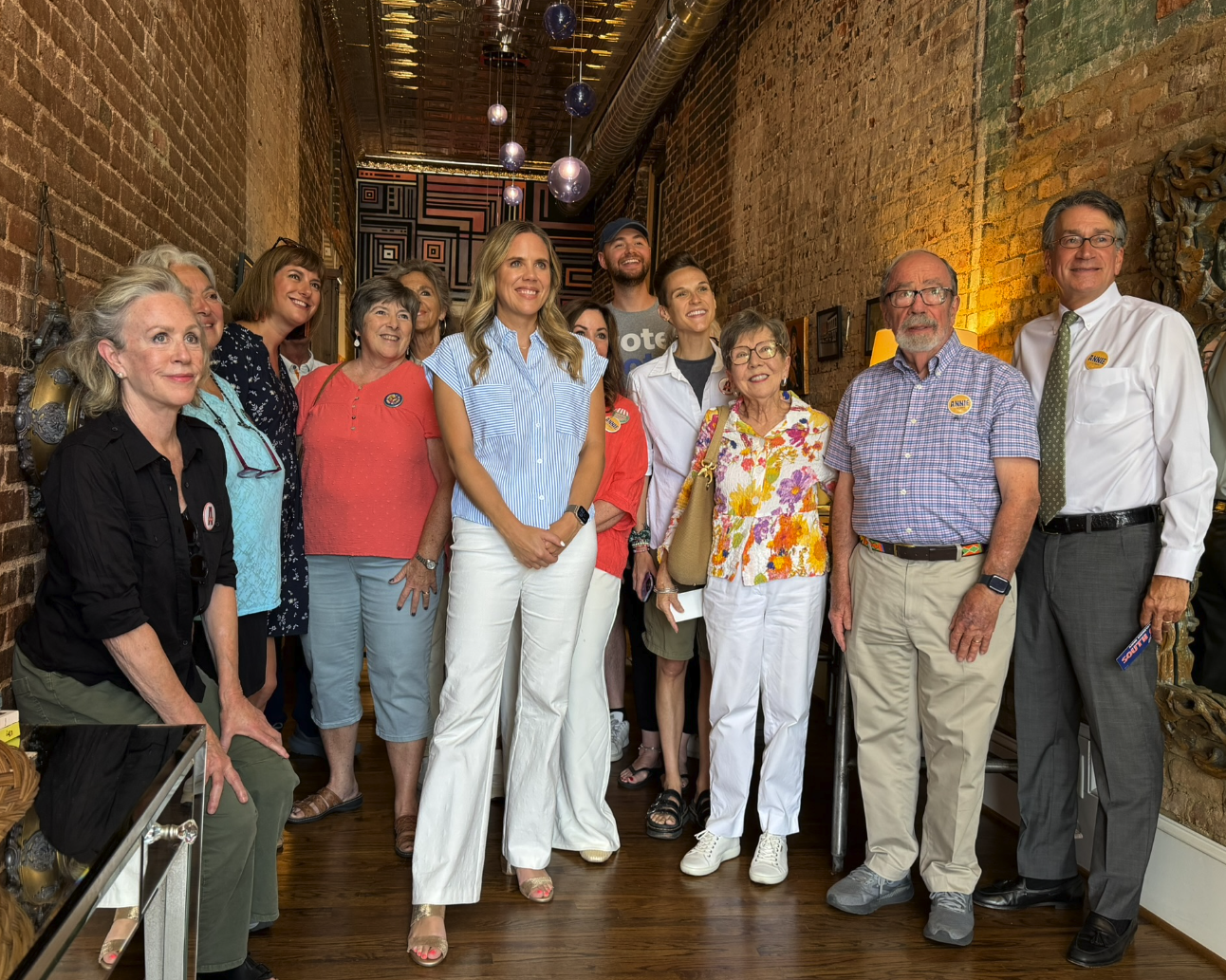
Senate Democratic Hopeful Takes Aim at Divisive Politics
Greg Wilson/Anderson Observer
Democratic U.S. Senate hopeful Dr. Annie Andrews visited Anderson on Thursday to campaign in the days leading up to the special election primary which will determine who she faces on the ballot in November. As part of her visit, she sat down for a brief chat with The Anderson Observer to outline the key goals of her campaign.
In her visit to Anderson on Thursday, Dr. Annie Andrews said she stepped into the Senate race less as a partisan combatant than as a pediatrician startled into politics by the way politics has come to govern the ordinary business of life.
Andrews, the Democratic party’s candidate for the South Carolina United States Senate seat in November, said the death of U.S. Sen. Lindsey Graham, who she was to face in the election, did not so much reorder her mission as alter the field around it: the opponent changed, but the cause did not.
Andrews said her campaign had pivoted from a primary posture to a general-election one, with the same message now directed toward a different set of ears — independents, persuadable voters, and Republicans who feel abandoned by their party’s drift toward extremity. That shift, she argued, leaves her in a valuable position, with Republicans spending their special election primary season racing one another to the right, saying things on television that have little to do with gas prices, grocery prices, or the health-care crisis she believes is actually animating the state.
Andrews embraces a moral vocabulary that is disarmingly plain. Life, she said, is bigger than politics and South Carolinians have more in common than they are permitted to remember. The country’s current style of hyper-divisive politics, in her view, is not merely tiresome but corrosive, and one of the things she is offering is the quiet, unfashionable idea that an adult in the room should still exist.
Her pitch rests heavily on the habits of medicine. As a pediatrician she is accustomed to entering a room with a sick child and worried parents, quickly sorting through the facts, making a diagnosis, and explaining a treatment plan in a way that ordinary people can understand. Politics, she said, should be a version of that same work: assess the problem, set aside the vanity of blame, and do what is needed.
When asked about how she would serve the Upstate, sensibility leads her to infrastructure, where she sees federal policy not as abstraction but as the mechanism by which roads, pipes, and public systems either arrive or do not. She praised the Biden infrastructure bill for bringing critical money to South Carolina and said she would vote in Washington according to what helps the state, not according to a party script.
A career to fall back on, she argued, makes that kind of independence possible, giving a politician less reason to treat every vote as a threat to their very survival.
On healthcare, her approach is more urgent and specific. Andrews said her priority in the Senate would be stopping impending Medicare budget cuts, which she believes would land especially hard on rural South Carolina, where many counties already lack OB-GYNs, pediatricians, and mental-health providers. Her warning is that these cuts would not merely strain a fragile system but deepen a crisis that has been building for years, especially in places that rejected the cushion of Medicaid expansion.
Andrews said the state is already operating with too few physicians and too little margin and to cut again would be to ask under-resourced counties to absorb another wound. That is why she has spent time in Washington talking to senators about whether a Democratic House and Senate could stop the cuts before they take effect.
Andrews also said her campaign is an answer to the peculiar inertia of South Carolina politics, where straight-ticket voting (51.4 percent of the state’s voters voted straight ticket in 2024) remains a formidable habit. Andrews plainly regards that as part of the disease in need of a cure. Her hope is to persuade voters to evaluate candidates individually, not reflexively, and to see her first as a doctor and a mother, and only afterward as a Democrat.
That is the paradox she seems to understand best: in a red state that often rewards partisanship as identity, she is trying to run as a practical person. She says what she means, means what she says, and is not afraid of a fight.
She insists that if she loses, she will remain in the arena on behalf of South Carolina’s children and families. That reveals both promise and warning, delivered with the kind of calm conviction that in the current political climate seems radical.