Opinion: One-Percent Roads Referendum Critical for County’s Future
Greg Wilson/Anderson Observer
In the sprawling networks of Anderson County, the cracks run not just through asphalt but through the very fabric of public works funding. With election day looming just weeks away, county leaders broker a stark bargain: fix the roads and bridges—or face a future where deterioration is the only constant. The choice, they insist, is unequivocal. There is simply no other option.
Anderson County’s infrastructure—a vast tapestry of 1,554 miles of roads and 162 bridges (of which almost all have weight limits and one-third cannot be crossed by a firetruck or school bus)—stands at a precipice. The financial reality, laid bare in council chambers, reveals that only three cents on every tax dollar are currently allocated to roads, bridges, and solid waste, while education, law enforcement, and general government consume the bulk of resources.
“We have wonderful schools, a fantastic sheriff’s office, and the best emergency department in the Southeast,” said Councilman Jimmy Davis at a meeting earlier this year, “but we have to find a way to fund roads.”
The solution presented to voters is a one-penny capital sales tax, a dedicated revenue stream poised to generate approximately $350 million over eight years. Remarkably, 35 percent (more than $122 million) of this money would come from visitors rather than residents, infusing fresh capital into the local coffers. The funds are restricted by law to be used for road and bridge repair and cannot be transferred for other uses.
Yet this levy, a targeted effort designed to sidestep current budgetary restraints, also underscores a sobering truth: no other funding mechanism exists to address the county’s urgent infrastructure needs.
Councilman Chris Sullivan dispelled misconceptions with directness that cut to the heart of the matter. “There is no county sales tax money for roads currently,” said Sullivan, emphasizing the distinct nature of the proposed tax and its exclusions—including most groceries, gasoline, and prescription medications.
The county worked with municipalities to list the roads deemed in greatest need of immediate attention. (Complete list here). Public safety was also factored into the list, since poor roads are challenging for law enforcement and first responders including the cost of damage to their vehicles.
More than a third of all county roads are already in poor or failing condition, bringing a price tag of $1 million per mile to remedy. Again, one-third of the bridges in the county cannot be used by firetrucks or school buses due to their aging or questionable structures.
Currently the county hovers in a patch-and-save mode, since funding is limited. And sadly, no other sustainable funding source for roads and bridges is not in sight.
Funds generated by the South Carolina Gasoline Tax bring in around $6 million annually for the county, with most of that money going for state roads funding.
This referendum, if approved, will usher in an era where improvements can begin in earnest, propelled initially by a $20 million bond to jump-start projects ahead of the tax revenue’s flow.
For Anderson County, the referendum is not just a ballot initiative. It is a crossroads. Without it, the roads and bridges that knit the community together will continue to erode, isolated from the funds necessary for repair. With it, there is hope—however hard-earned—that preserving the county’s vital arteries is within reach. The message is clear: there is no viable alternative. The time to act is now if roads and bridges are to be saved.
The argument that it will be a financial hardship rings hollow. A one-penny sales tax is not a financial strain on any citizen, and those who suggest it is are disingenuous. The cost of vehicle/tire repair caused by poor and unsafe roads is far greater than would be paid by this one-percent tax.
A “Yes” vote on November 4 is crucial to the county’s future, including economic development (companies consider road conditions when scouting locations) as well as the safety of our citizens.
A “No” vote will mean more crumbling roads, higher vehicle maintenance costs and decreased safety for all drivers in our county.
Let’s hope Anderson County voters look to the future and approve the capital sales tax for roads referendum.
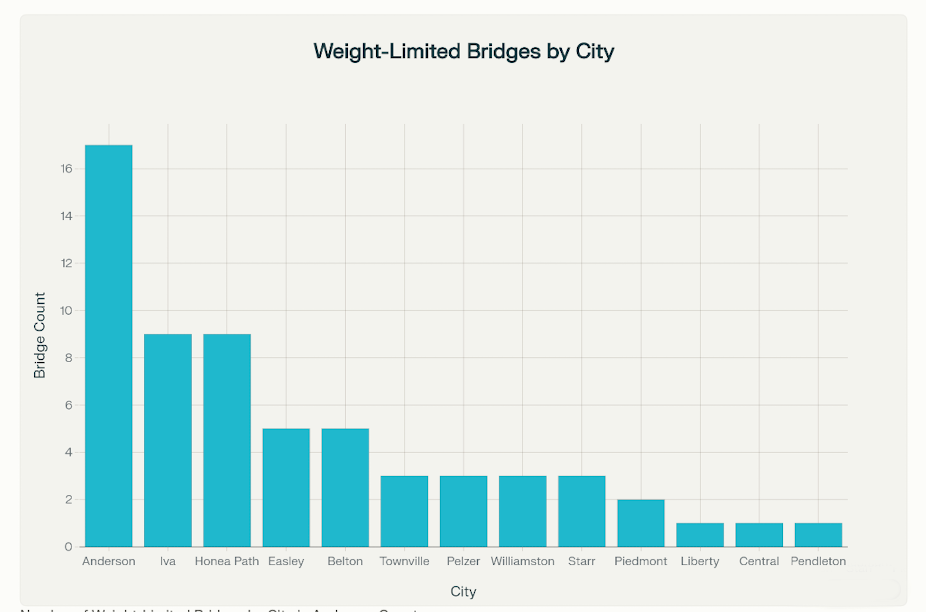
This lists includes Anderson County bridges in need of repair by region.