SCDOT Visits Anderson for Comments on S.C. 28 Safety Project
Greg Wilson/Anderson Observer
Eugene Taylor drives to the places where people have been injured or killed on roads and is part of a team that tries to figure out why and what can be done to improve safety. Taylor is with the Office of Traffic Safety at the South Carolina Department of Transportation, and his program — the Roadway Safety Assessment Program, known within SCDOT as the RSA — is built on the strategy of taking the statewide crash data, identifying the locations where it concentrates, and investigate those locations in person until you understand what the road is doing wrong.
Once a location clears the data threshold and lands on the RSA list, Taylor's office dispatches a team for a field review/field audit — two days of walking the corridor during peak hours, watching traffic move, counting pedestrians and cyclists, and observing the friction points that aggregate crash statistics can suggest but never fully explain.
The team includes staff from SCDOT headquarters, local DOT personnel, and a broad collection of stakeholders: municipal officials, law enforcement, fire and emergency services, and sometimes elected council members who want to see for themselves what the data suggests. The goal is to examine the road from a full lens — every mode of travel, every category of user — and to find anything that can be improved.
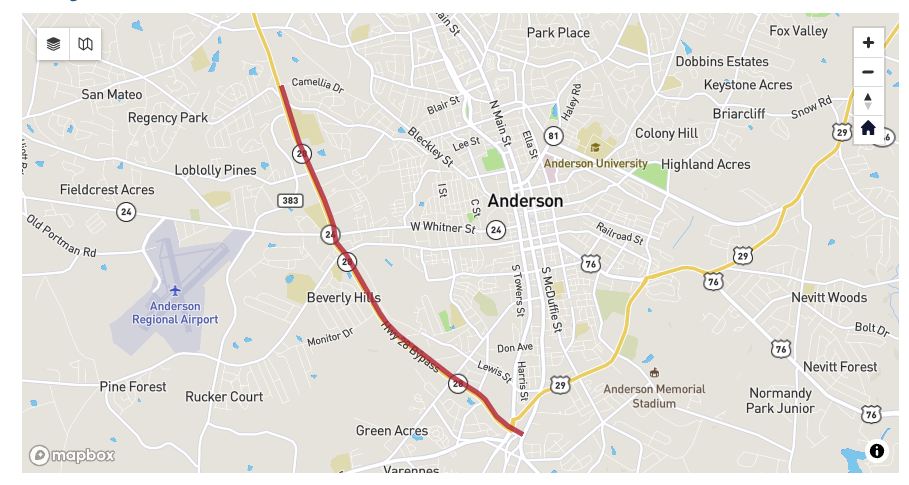
Next comes the Roadway Safety Assessment report, a document that records the findings and translates them into specific recommendations. The concept presented at a Tuesday’s public meeting in Anderson — a high-level rendering of what SCDOT believes can be accomplished along the SC 28 corridor — is the direct descendant of that report. From field observation to written findings to proposed design: the pipeline is clear, but can be slow.
The RSA program is federally funded through the Highway Safety Improvement Program, which means that when SCDOT identifies a location for study, the funding for everything that follows — the study, the report, the concepts, the design, and the construction — is allocated at the outset. That means the funding is covered.
The current Anderson location on the busiest part of the S.C. 28 corridor was identified during the 2022 RSA cycle, which flagged approximately 20 locations across the state. Work on those sites is ongoing. A new RSA list was approved by the DOT Commission earlier this year, and Taylor's office will begin working those locations in parallel. The program runs on a roughly two-year cycle of identification, audit, design, and construction, then starts again.
The program focuses deliberately on the worst outcomes — fatal crashes and crashes causing serious injury. Everything else is context.
"One fatal crash is one too many," Taylor said.
Before-and-after studies are required under the federal program for every location that receives improvements, which means Taylor's office generates not just recommendations but evidence. The evidence, across locations the program has addressed, shows crash reductions ranging from twenty to eighty percent, depending on what was wrong with the road and what was done to fix it. That is a wide range, and Taylor offered it without embellishment: some problems are more tractable than others, and the data tells you which is which.
For Anderson County residents who missed the public meeting, SCDOT's project portal, accessible at the department's website, has a comment section for the SC 28 Anderson corridor study. Comments are open through June 16.