Corps to Keep Lake Level Lower Due to Cracks in Clemson Dike
Greg Wilson/Anderson Observer
Monitoring Hartwell Lake’s water level is a popular pastime for those who live on the lake or spend time along the shoreline. It’s something locals watch and post updates on social media throughout the year.
For most visitors, those numbers become visible only at the boat ramp, where a low shoreline may mean a longer walk to the water, or at a dock whose gangway has taken on an unfamiliar angle or is a bit grounded.
Now, one of those numbers has acquired a more urgent meaning.
The U.S. Army Corps of Engineers’ Savannah District announced Wednesday it is imposing long-term restrictions on how high Hartwell Lake may rise because of a structural concern at the Clemson Lower Diversion Dam Saddle Dike, an earthen barrier associated with the lake’s flood-control system. The Corps maintains there is no immediate danger to the public, but its most recent Dam Safety Program evaluation found that the dike’s condition does not meet the agency’s acceptable risk standards.
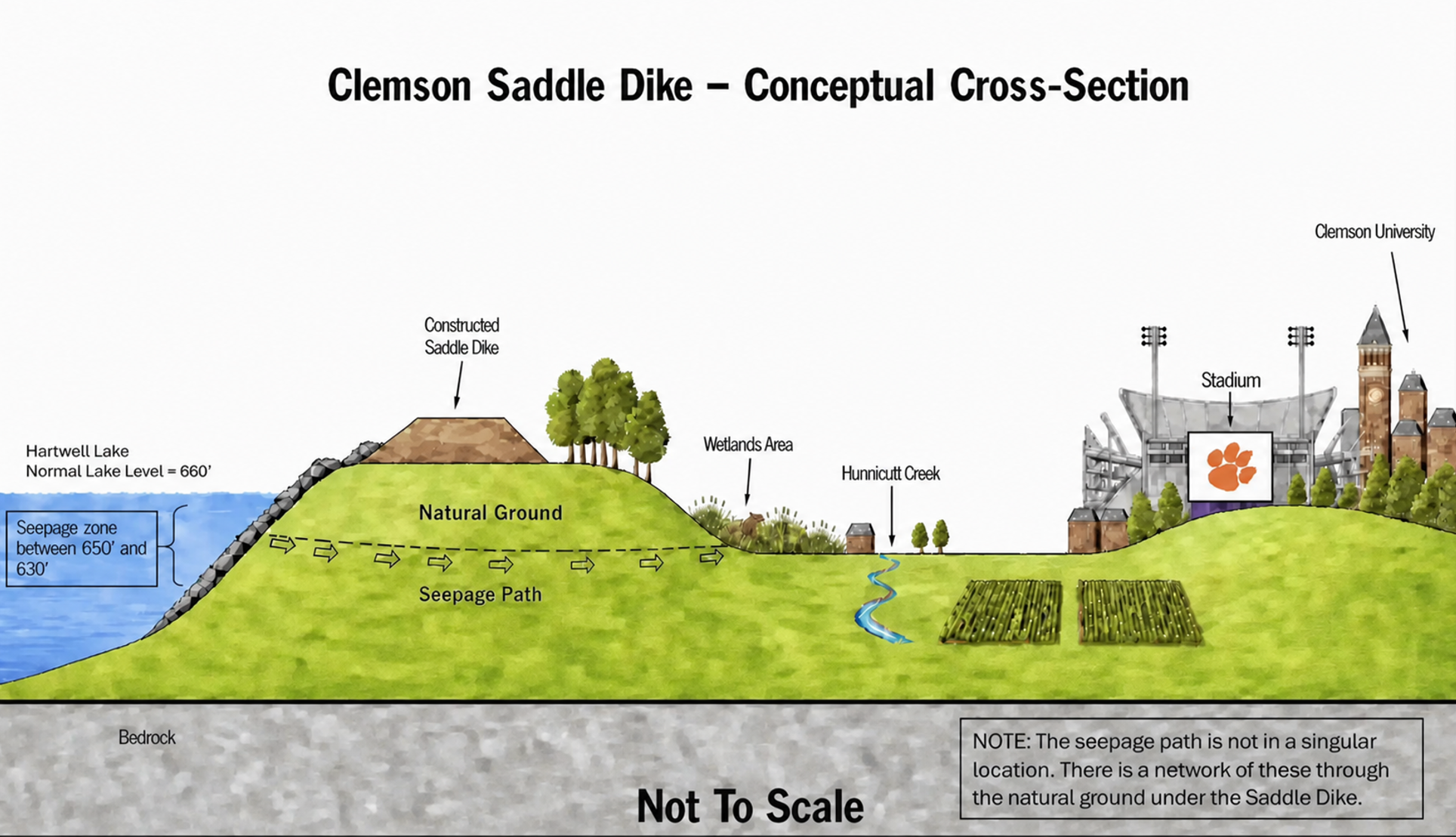
The condition, “seepage deterioration,” describes an elemental problem. Lake water is finding small cracks, loose zones and pathways in the earthen structure, moving beneath and through the dike. Seepage has been a recurring maintenance concern at the site since 2015, but recent evaluations concluded that it now requires a permanent engineering remedy.
The Corps told The Anderson Observer that during their detailed safety evaluations and monitoring, engineers identified water seeping through and under the Clemson Lower Diversion Dam Saddle Dike (Saddle Dike) through a network of seepage paths. Over time, water seeping through a soil structure can slowly wash away fine soil particles, carving out tiny tunnels in a process called "piping" or backward erosion. If left unaddressed, this process weakens the dike and can eventually cause the structure to give way.
Until that work is designed and built, the Corps is reducing the pressure on the dike by keeping more empty space in the lake.
The restrictions establish two important elevations:
Hartwell’s normal full operating level, known as the guide curve, will be held at 656 feet above mean sea level year-round.
The Corps will keep the lake below a hard maximum of 662 feet above mean sea level.
The difference between those figures, six feet of water, is not an abstraction. It is reserved flood-storage capacity, a buffer intended to absorb rainfall before rising water can place additional stress on the Clemson Saddle Dike.
If heavy rain pushes the lake toward the 662-foot ceiling, dam operators will work to return it to 656 feet as quickly as conditions permit, with a goal of doing so within seven days. The Corps says the measure is intended to reduce both the water pressure on the dike and the flood risk to Clemson University and surrounding communities.
The lake is currently below the new 656-foot operating level because of drought conditions. As a result, the new policy does not require an immediate drawdown. It functions, for now, as a ceiling on future recovery rather than a sudden reduction in the water already on the landscape.
That distinction will matter to lake residents, marinas, anglers, boaters and businesses. The Corps also acknowledges that lower levels can affect hydropower production, recreation and the local economy. But it has placed those concerns beneath the larger obligation of dam safety.
“Safety is our priority,” said Justin Nixon, the Savannah District’s Dam Safety Program manager. “The current condition of the Clemson Lower Diversion Dam Saddle Dike does not meet the USACE’s acceptable risk standards.”
“This is going to have a very significant impact for people who live on the lake and those who visit the lake at boat ramps and other locations,” said Anderson County Administrator Rusty Burns. Burns said the decision will have no impact on Green Pond Landing and Events Center since it was built on deep water and prepared for such contingencies.
Due to the ongoing drought conditions, Corps officials are urging boaters to use extreme caution when at the lakes. Rocks and tree stumps, normally deep underwater, are closer to the surface, some just out of sight, especially in coves and along the shoreline. Boaters are advised to use the main channel whenever possible. All visitors should wear a life jacket whenever in, on or near the water. Boaters should navigate with extreme caution, wear life jackets, and avoid drinking alcohol while operating vessels. Swimmers should be aware of underwater obstructions and sudden drop-offs while swimming outside designated areas and it is recommended that all swimmers wear a life jacket and never swim alone.
Anderson County Councilman Chris Sullivan, who has a place on Hartwell Lake, said the announcement brings frustration to many residents.
Sullivan said he and his neighbors built a sea wall to prevent muddy conditions and erosion of the shoreline, but the new rules could leave the bottom of those walls exposed.
“This is a big deal, a lot of us who obeyed the rules in place and are now left hanging by this announcement,” Sullivan said. ““I guess now that we have to wait and see what the options are.”
The Corps also added that water treatment facilities will not be affected by the new levels.
“We have evaluated municipal water intakes around Hartwell Lake and the lake level restriction level of 656 feet MSL keeps water levels well within the safe operational limits for local water supply systems, ensuring clean and reliable drinking water continues to reach local homes and businesses,” said Dixon.
The Corps’ release said that while there is no immediate public emergency, the agency has determined that the risk cannot simply be watched and managed as before.
A formal study has not been started to determine the cost to repair the Clemson dike. The lake restriction is anticipated to remain in effect until a Dam Safety Modification Study (which will include a cost estimate) and the associated recommended construction to address structural deficiencies in the Clemson Saddle Dike are complete.
The length of that process is uncertain. The study must define the problem, test alternatives, select an approach, secure approvals and funding, and then move into construction. In the meantime, the lake’s operating level becomes the principal tool available to reduce stress on the structure.
The Corps plans to hold two virtual public meetings to explain the engineering findings, the lake-level restrictions and the next steps. Dates and access information have not yet been announced. Updates will be posted through the Savannah District’s Hartwell Project website and social-media channels, and questions may be sent to CESAS-HartwellPoolrestriction@usace.army.mil.
At Hartwell, the new management rule is a reminder that a lake is never simply scenery. It is an engineered reservoir held in place by structures that must withstand weather, time and the invisible pressure of water. For the foreseeable future, the Corps will keep more room in the lake — not because the danger is immediate, but because the consequences of waiting for it to become immediate would be too great.