CodeWright Planners Offer Updates, Citizen Feedback on Development at Meeting
Greg Wilson/Anderson Observer
Documents that govern how Anderson County grows — what gets built, where, at what density, under what conditions — are not generally a pleasure to read. They are generally a collection of zoning ordinances, a creature of lawyers and planners and decades of accumulated amendments, written in the language of legal precision and revised in the language of legal precision, until the cumulative effect is something that requires professional translation before a citizen can understand what it permits them to do with their own land.
Anderson County, which has watched development pressure arrive from the north and east with the steady intensity of a growing storm, decided last year that this was no longer acceptable. In April 2025, county council approved a $380,000 contract with CodeWright Planners, LLC, a firm with an unusual specialty: working with the county on reasonable standards and making those planning and zoning codes readable.
Chad Meadows, CodeWright's principal, held a public meeting Wednesday at the Anderson Civic Center to update citizens on where that project stands and to collect the community's reactions to a process that, he acknowledged, is still in its early stages.
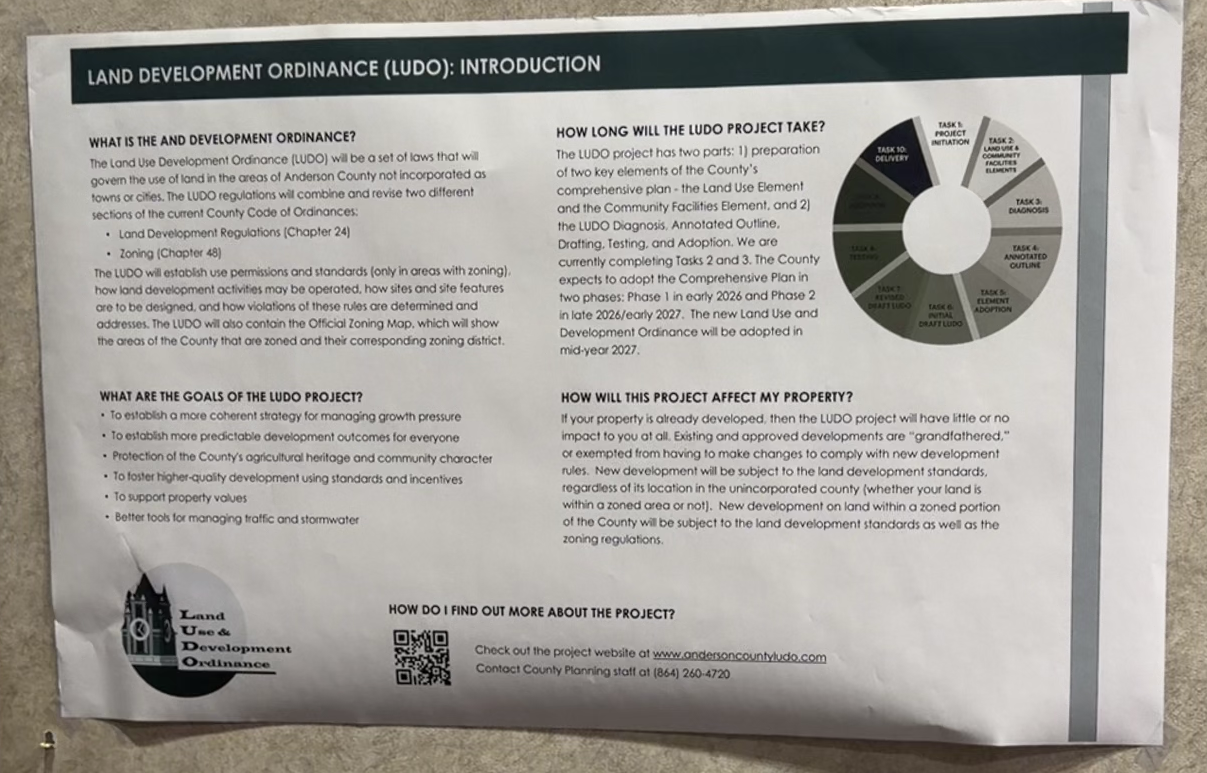
The contract runs through April 2027, and what it aims to produce is a new Land Use Development Ordinance, known in the planning trade as a LUDO, written in plain English, illustrated with graphics, structured to be navigated by someone who did not go to law school, and designed to give citizens and developers alike a document they can read and agree on what it says.
The milestone most recently cleared to facilitate forward momentum is the adoption of both parts of the county's 2026 Comprehensive Plan, which provides what Meadows called "the policy guidance" that underlies everything the new ordinance will attempt to translate into regulation. Th”at foundation now in place, his firm is working on the code diagnosis” — a document that maps the recommended changes to the county's current regulations and explains the reasoning behind each one.
"Think of it as the roadmap," said Meadows. That roadmap will be available for public review within the next few weeks, and Meadows invited residents to study it and return in July, when his team will be back in the county for another public session.
The feedback received will shape the next phase: an annotated outline of the new ordinance, which he described as "the dress rehearsal" — a document that establishes the structure, contents, and basic framework of the LUDO before full drafting begins.
He expects the outline work to run through late summer and fall, with drafting beginning in late 2026.
The project has a complication that Meadows said distinguishes Anderson County from most of the communities where he has done similar work. Part of the county is zoned. Part of it is not. That division — unusual among South Carolina counties of Anderson's size and growth trajectory — means the new ordinance must be designed to function differently across different parts of the same county, addressing the pressures of development in areas with existing regulatory frameworks while finding tools that work in areas where no such framework currently exists.
"That's an important part of this process that's a little bit different from where we often work," said Meadows, with the diplomacy of a consultant who has spent time in many county meetings, that the staff and elected officials are engaged and working toward a solution.
When asked what the project is not doing — a question prompted, apparently, by some confusion in the public — Meadows was direct. The building code is state law and not within the scope of the engagement. Nuisance ordinances, noise regulations, and law enforcement matters are staying in the county code and outside his purview. Economic development — attracting new industry, recruiting employers — is not his firm's function.
"Our job is to make sure that the development that does come here fits within the context that's here," he said, "and that we manage the resources that we have."
CodeWright has done this kind of work across the Carolinas — in Winston-Salem, Forsyth County, Mills River, and Weldon in North Carolina, among others — and Meadows said the reaction, once the work is finished, is typically relief.
These are labor-intensive projects that involve a great many people over a long time, and the communities that have been through them tend to be pleased with the outcome. Meadows was careful to push back against a common assumption: that a finished code is a finished problem.
"These are living documents," he said. "Just because you finished it doesn't mean it's perfect, doesn't mean it stays perfect."
The revision process, he said, begins shortly after adoption, as the community learns how to use the new regulations and discovers what still needs adjustment.
His personal measure of success is specific, and it says something about what a good development code is for. If developers who have applications pending under the old regulations withdraw them in order to resubmit under the new one — if the new rules are clearly preferable to the ones they replaced — then, Meadows said, "we've done what we said we were going to do, which is make things better, easier, more appropriate."
That is not a modest goal for a county that is managing 174,000 acres of farmland, 3,000 miles of roads, and the pressures of a region that more people are choosing to move toward every year. It is, however, a legible one — which is the entire point.