City Council to Hold Initial Vote on Edgebrook Annexation Project
Greg Wilson/Anderson Observer
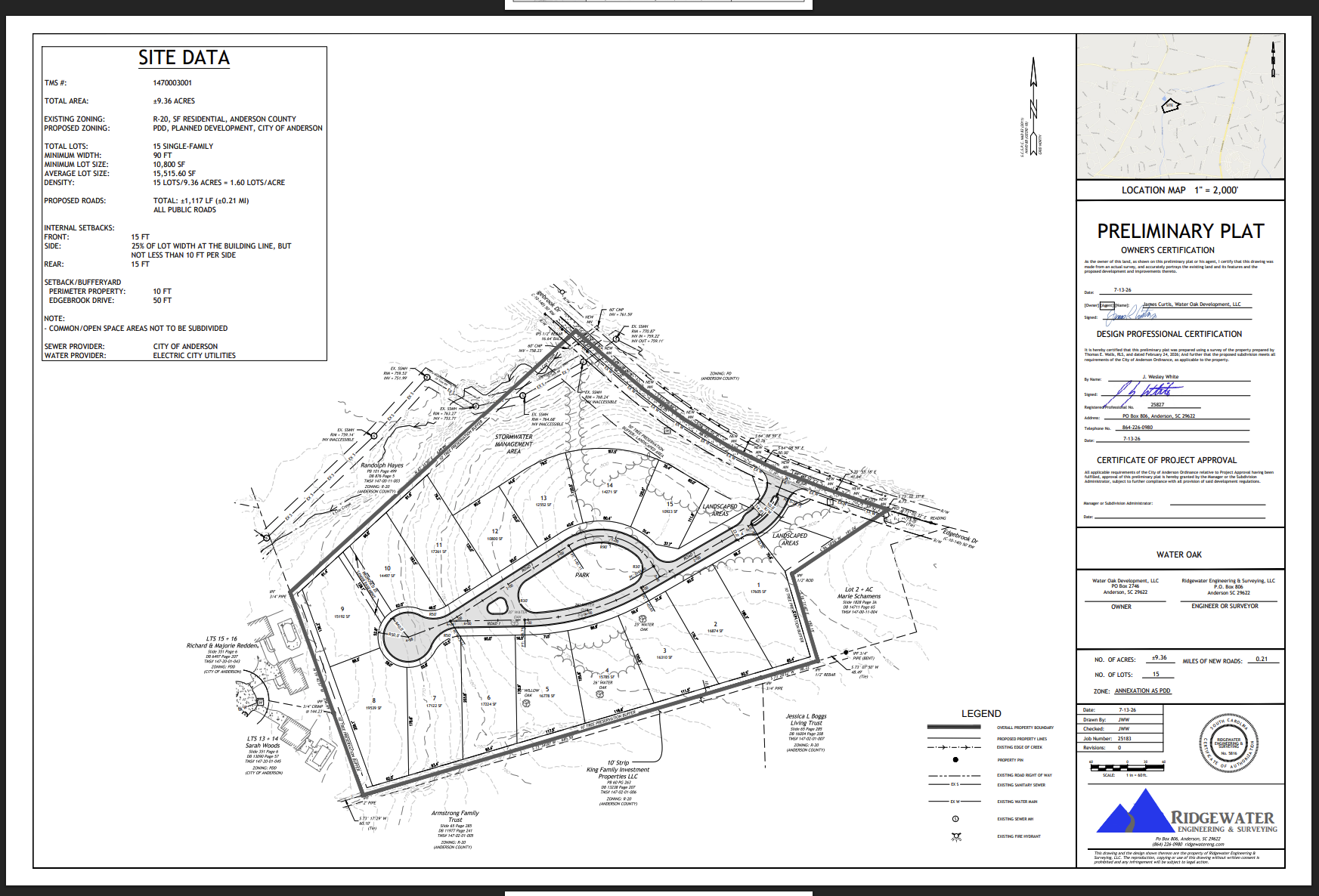
Anderson City Council on Monday will hold first reading vote on an annexation project off Edgebrook Drive, east of Concord Road and south of the Richard A. Shirley Parkway. The proposal is a familiar one: 9.36 acres, 15 homes, a house already standing that will come down to allow new construction to rise in its place.
The applicant of the proposed Water Oak subdivision would contain 15 custom-built, detached single-family homes on the cul-de-sac, and a green space park. Most lots would exceed 15,000 square feet, with one at 12,000 and two at just under 11,000 square feet
The annexation is tagged as a Planned Development District designation, a zoning category that has minimum lot widths of 85 feet; 15-foot front and rear setbacks; and 7.5-foot setbacks on each side. Street trees would be planted every 40 feet. Sidewalks would run along both sides of new streets and extend beside adjacent portions of existing streets. A 50-foot landscaped buffer would separate the development from Edgebrook Drive, and a 10-foot buffer would surround the rest of the subdivision.
A survey is underway to identify specimens and established trees that can be preserved. When preservation is not possible, trees would be replaced in accordance with the city’s landscape standards.
Across the street sits a subdivision where the average lot is smaller than 8,000 square feet. Nearby are townhomes and patio homes. Elsewhere along the road are larger lots.
While the application was filed before the new Unified Development Ordinance was adopted, Water Oak will proceed under the existing PDD process; the city has concluded that it would make little sense for the development to evade the central design principles of the new ordinance simply because it arrived early.
The city’s Comprehensive Plan does not directly address the property because it remains outside city limits. Yet the proposal fits within the plan’s broader single-family residential category and closely resembles the low-to-medium density pattern.