Church Street Park Expansion Expected to Begin in Fall
Greg Wilson/Anderson Observer
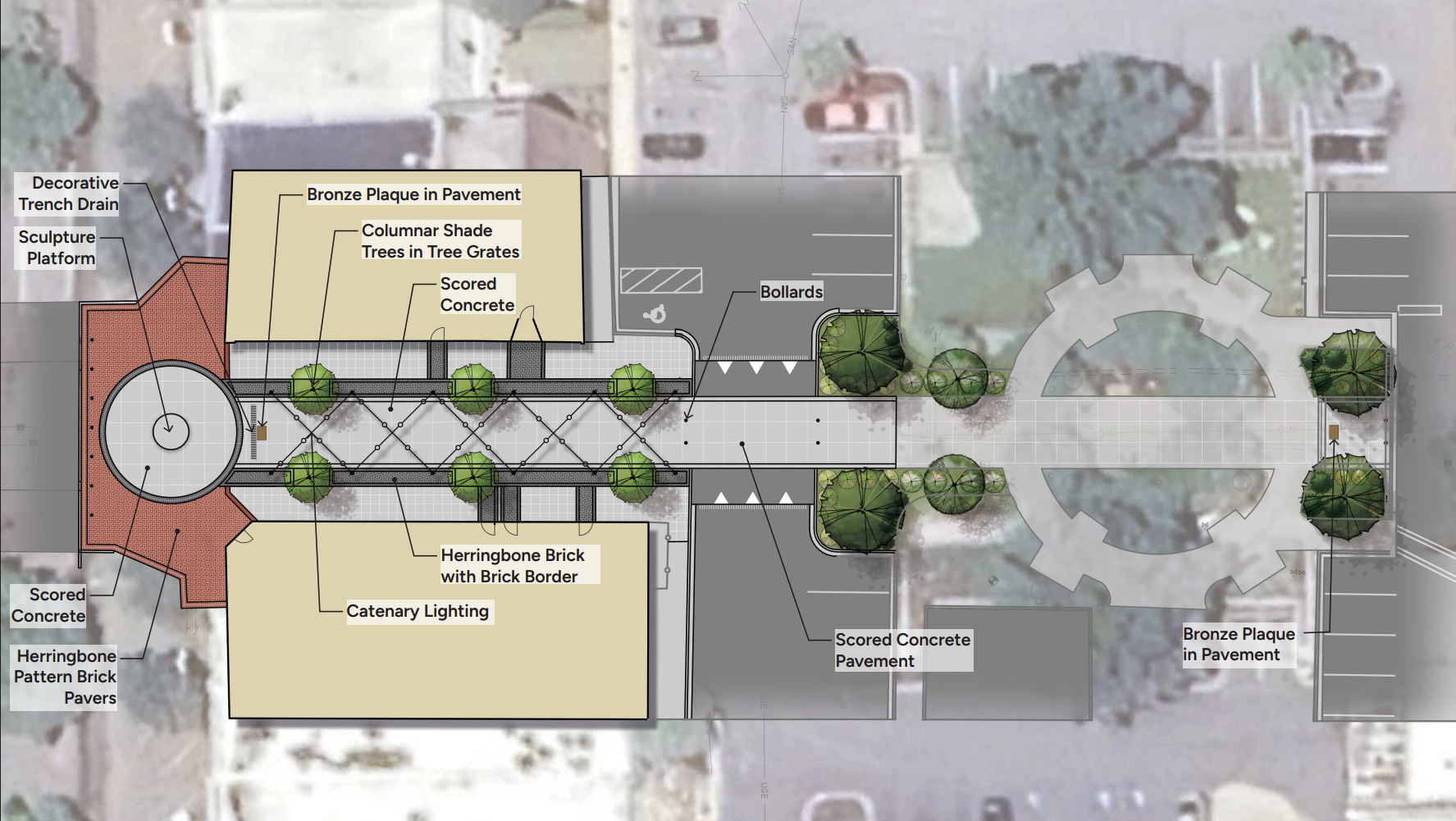
Phase 2 of the City of Anderson’s Church Street Pedestrian Plaza project would remake a downtown block and its connection to Church Street Heritage Plaza, near 115 E. Church St., into a continuous public space extending from South Main Street toward the park and nearby parking. The project has been moving through design and public-input stages since late 2025, and City Council is expected to consider its details Sept. 14.
The changes on the area once open to traffic, include some demolition, paving, drainage, curbs, conduit to make the project more meaningful and sustainable. The city proposes to replace the present patchwork of brick crosswalks, concrete and granite curbs, sidewalks and asphalt with new sidewalks and crosswalks, brick pavers, asphalt, drainage inlets and piping, low-voltage lighting, tree grates and other streetscape details.
The work would recast the block from a place that cars once used to pass through into one that pedestrians can inhabit.
The city has characterized the project as an improvement to the existing street and Heritage Plaza rather than an expansion of the park. What people walking downtown will notice is the removal of a lingering in-between space — part roadway, part event venue, part unfinished edge — and its replacement with a permanent gathering place.
The project’s location gives the redesign a significance beyond landscaping and paving materials. Church Street Heritage Plaza opened in 2017 to commemorate the historic Black business, cultural and entertainment district that once flourished along East and West Church streets in the 20th century.
The original heritage project, supported by the City of Anderson, the Anderson Arts Center, the National Endowment for the Arts and the Duke Energy Foundation, brought clay reliefs, marble sculpture and animation to the site and was designed as a place of remembrance: a physical acknowledgment that the life of a downtown is shaped not only by its storefronts and traffic patterns, but also by the communities whose stories have too often been treated as peripheral.
Phase 2 extends that idea. The project aims to make the plaza more useful on ordinary days, when there is no festival, ceremony or public program to give the space a reason for being. It would offer a clearer pedestrian route between Main Street, the plaza, the green space and the parking area — while giving the heritage site the kind of setting that encourages people to stop, look, gather and return.
The project was included in Anderson’s 2025-26 capital planning alongside Main Street paving and trail-design work. City officials said in June that they hoped related downtown improvements could begin in the fall.
A good street, urbanists often argue, is not merely a device for moving vehicles efficiently from one point to another, but a piece of shared civic infrastructure where one can pause outside a restaurant, meet a neighbor, wait for an event to begin, or discover a piece of local history.