Broadview District Aims to Get Zoning on November Ballot
Greg Wilson/Anderson Observer
The Broadview Voting Precinct, which encompasses the Broadway Lake and the area around it, wants more control of what can be built in their neighborhoods.
The area, currently unzoned, so under county rules that land may generally be available for residential, commercial, or industrial development without the district-specific restrictions that zoning would impose. For residents who have watched Anderson County grow, and fought on recent proposed development, this absence of zoning has felt less like freedom than exposure.
Their proposal is not, its supporters insist, an effort to stop development altogether. It is an attempt to decide where development should go and where it should not.
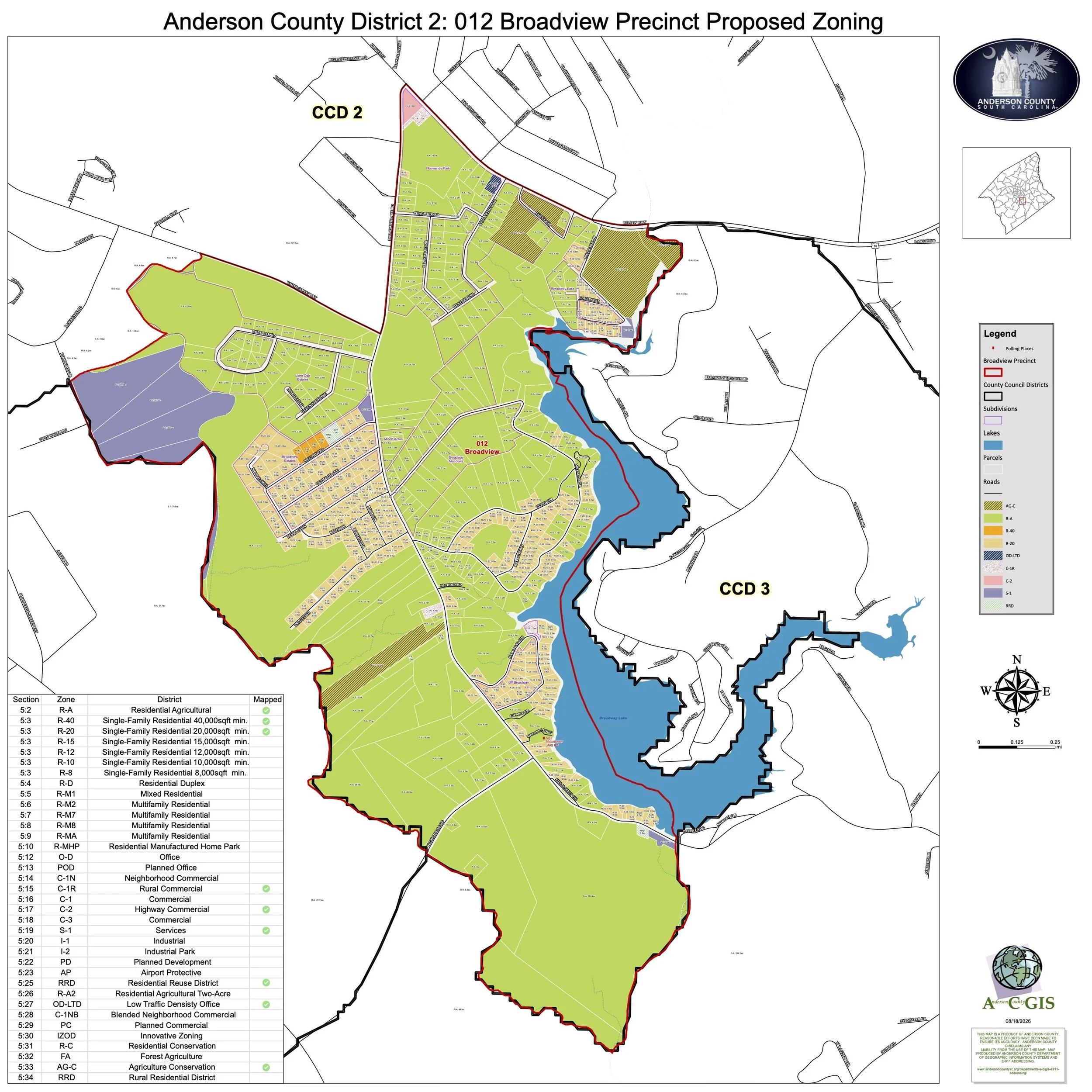
Residents reviewed the proposed zoning map on Monday, one which aims to preserve agricultural and lower-density residential areas while directing more intensive uses, including commercial, industrial, and larger subdivision development, toward places considered more appropriate for them. Residents have been reviewing maps showing current land use, future land use, and a proposed zoning pattern developed through early community input. (See map below)
The work follows a now-familiar sequence in Anderson County, the only county in the nation where zoning is organized precinct by precinct. To request a change in zoning, residents must first collect signatures to initiate the process, and if the proposed map gains sufficient support, county council must consider the ordinance through three readings and hold a public hearing. If it clears these hurdles, the question would then go before Broadview voters on Nov. 3, the date of the general election.
There is little time, but organizers believe the schedule remains workable. With roughly 80 days between the early-August signature effort and Election Day, the ordinance must move through council quickly enough to reach the ballot.
If voters approve the map, new development proposals that have not already received approval would be subject to the new zoning districts and their requirements. Existing approvals would generally remain in place, but projects still awaiting approval would have to meet the standards established by the adopted map.
The Broadview effort reflects a wider movement across Anderson County and is the fifth precinct to begin the zoning process in the past two years, with four more precincts expected to follow. The surge comes as residents confront a paradox shared by many fast-growing places. While not necessarily opposing new people, new homes, or new businesses, they fear what happens when growth has no agreed-upon boundaries.
“People want to preserve Anderson,” said Henry B. Youmans, Zoning Administrator/Title VI Coordinator Anderson County, adding residents are requesting responsible development. “It comes through setting guidelines, which is zoning.”
The issue is especially urgent because roughly two-thirds of Anderson County remains unzoned. That has made those areas attractive to developers seeking fewer restrictions, while leaving residents with fewer formal tools to shape how their communities change.
County Councilman Glenn Davis, who represents this district, said the initiative must begin with the people who live there.
“The people of the district have to speak, and they have to initiate this,” Davis said. “It is something that’s coming from the populace that they would like to see.”
Davis said he intends to support the residents’ effort, while acknowledging the tension at its center. Many longtime residents want to protect the landscape and pace of life they have known for 15 or 20 years. At the same time, the district cannot simply freeze itself in place. “They’re not totally against growth,” he said. “It’s just that the rapid growth” is what concerns them.
That is the balancing act now being negotiated at Broadway Lake, how to allow a community to evolve without letting it become unrecognizable to the people who have spent years calling it home.
The recent movement has already reached several parts of the county. In 2023, voters in the Fork 2 Precinct, near Lake Hartwell, approved zoning with about 70 percent support. In 2025, the county also held community meetings and prepared zoning proposals for the Rock Spring, Neal’s Creek, and Shirley’s Store precincts, all communities where residents sought a clearer framework for future residential, commercial, and industrial growth.
This year, the Center Rock Precinct became the latest district to adopt a zoning map, with voters approving the measure by a 452-95 margin in the Aug. 11 referendum. The map places most of Center Rock in Residential Agricultural zoning, with smaller areas designated for single-family residential and existing industrial uses. County council is scheduled to take final action on the Center Rock map on Tuesday.