News Analysis: County’s Economy Robust, but Fragile
Greg Wilson/Anderson Observer
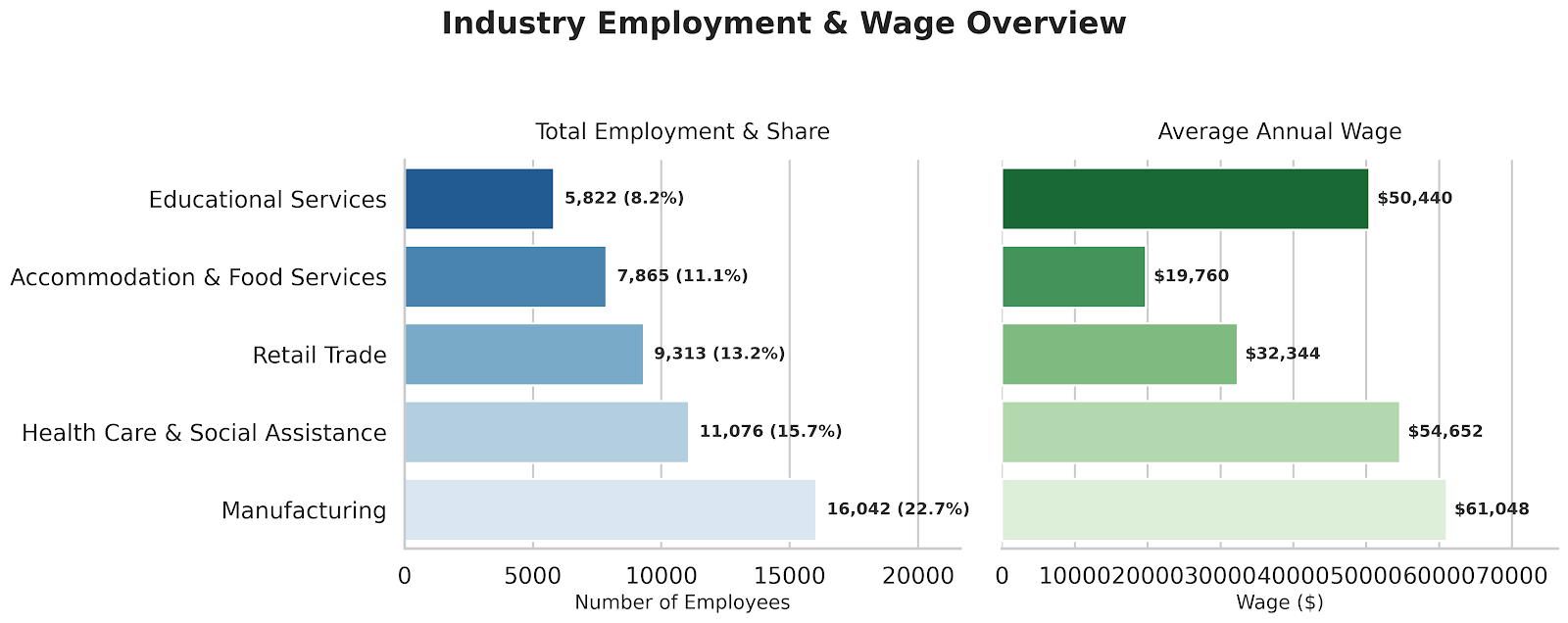
Anderson County’s modern economy is a glowing palimpsest, with layers of riveted steel and sanitized corridors revealing a resilient, if never-endingly precarious, prosperity. Manufacturing remains the spine of business, with 16,042 workers, or 22.7 percent of the strong labor force, who toil in more than 230 factories scattered across the county’s 715 square miles. In that production, they forge automotive components at Robert Bosch’s humming lines (1,001 to 2,500 strong), chill the nation’s refrigerators at Electrolux’s expanded plant, and mold tires at Michelin’s regional colossus, which claims 5,000-plus jobs in the Upstate sprawl. Techtronic Industries adds power tools to the mix, Arthrex sutures orthopedic futures, and First Quality provides paper/tissue products for the nation—diversifications born from the ashes of Hartwell-era mills. Wages here average $61,048, a notch above the county’s $48,004 mean, but the sector’s 5.4 percent projected growth to 29,351 jobs by 2032 trails the explosive 34.3 percent surge in transportation and warehousing, hinting at logistics’ creeping encroachment.
Yet it is healthcare and social assistance—the quiet colossus next door—that claims the second throne, with 11,076 employees (15.7 percent) and the heaviest expansion trajectory: 15.8 percent to 19,034 posts over the decade. AnMed Health, the county’s paramount employer, marshals 3,600 caregivers—up 2.1 percent year-over-year—across its Anderson flagship (2,816 staff), the Rehabilitation Hospital, a Cannon campus in Pickens, and clinics threading into Georgia. Practitioners command $93,550 annually in the Greenville-Anderson metro, support roles $35,630, all averaging $54,652 countywide—a buffer against retail’s $32,344 or food service’s $19,760. This sector’s tendrils extend far: a 2026 model forecasts $86.8 million in fresh output from expansions alone, mirroring South Carolina’s hospitals, which churn $36.75 billion statewide with a 1:1 job multiplier, sustaining vendors from lab suppliers to lunch trucks. Arthrex’s life-sciences ripple here as well—$87 million regionally—blending biotech into the brew, drawing site selectors to a county whose GDP crested $10.56 billion in 2024.
The past year has crackled with momentum. December 2025 brought Advanced Metalworks’ $10.5 million Belton consolidation—a 156,000-square-foot laser-and-CNC lair at 117 Blake Dairy Road, birthing 69 jobs. Signature Foods USA followed in April 2026 with $11.5 million for refrigerated meats and dips, its inaugural U.S. plant promising 202 full-time slots. Sargent Metal Fabricators invested $9 million for precision plates (20 jobs over five years), Eastern Engineered Wood $18.7 million for laminates (31 hires), and Halton $2.6 million across unspecified lines (65 positions). Alliance Blvd Venture’s $15.5 million speculative build in Williamston rounds out the tally. Unemployment is a crisp 3 percent, and total jobs are nearing 95,880. More recently, Vertiv, the Ohio-based company known for tending the power and cooling needs of data centers and other digital strongholds, added the promise of 800 new jobs.
But fragility lurks: automation’s blade, tariff tempests from Washington, or a healthcare crunch driven by hedge funds, mergers and buyouts. For now, the factories drone and the monitors beep, a dual symphony sustaining the almost 230,000 souls in the county, their fortunes hitched to the world’s quiet appetites for manufactured goods and continuity. With the memory of the loss of first the textile industry and then a series of other large employers suddenly announcing the closing of their doors due to a decision made in another state or country (cutting more than 1,000 jobs since 2018), the county has vowed to continue to seek to bring in select industry as a hedge against the uncertainty.
The latest figures from the South Carolina Department of Employment and Workforce list the unemployment rate in Anderson County at 5.1 percent, listing 5,419 citizens capable of entering the workforce without jobs. As reference points, Greenville’s jobless rate is 4.8 percent, and Spartanburg is at 5.5 percent. Economists project the Anderson County job market to be strong through 2032, with overall employment projected to grow 8.7 percent to 159,043 jobs amid expansions in healthcare, logistics, and advanced manufacturing.
Healthcare and social assistance is expected to lead growth at 15.8 percent, adding 2,596 new jobs for a total of 19,034, fueled by aging demographics and AnMed expansions. Transportation and warehousing surges 34.3 percent, gaining 912 jobs to reach 3,571, as logistics hubs like Anderson Gateway Commerce Center draw FedEx and Harbor Freight.
Manufacturing is expected to add 1,512 jobs, up 5.4 percent to 29,351, supported by Bosch’s $45 million push and Vertiv’s local growth. Retail trade growth is forecast at 10.9 percent with 2,039 new jobs making the total 20,702. Professional and technical services rise of 13.8 percent are expected, adding 589 jobs to 4,860.
This reflects statewide trends. South Carolina should add jobs to 2.6 million, up 11.1 percent, led by education and health at 13.8 percent and trade and transport at 13.7 percent. The I-85 corridor’s positioning is expected to boost logistics and manufacturing hybrids as healthcare demand rises for practitioners and support roles amid skills gaps in advanced manufacturing and tech, with Tri-County Tech and Anderson University playing key roles providing these skills. Housing pressure will continue to mount from the job influx, but recession-resistant healthcare, with over 3,000 AnMed roles, could provide some stability.