
City to Show Off Cater’s Lake Upgrades Tuesday
Greg Wilson/Anderson Observer
On Tuesday morning, if the weather behaves, a length of ceremonial ribbon will be stretched somewhere along the shore of Cater’s Lake, a small, familiar body of water in Anderson that has lately undergone what cities now call “revitalization.” At 10 a.m., officials will gather, large scissors will be produced, and a place that was once mainly a backdrop—seen through car windows on College Avenue, or from the periphery of an afternoon walk—will be invited to play a more active role in the life of the town.
Cater’s Lake has been on the scene long enough to acquire the vague, affectionate status of “historic park,” the kind of municipal landmark that accumulates memories more quickly than it does amenities. The City of Anderson, having decided that memories alone were not quite enough, hired the landscape architecture firm DabneyCollins and the construction company Edifice to give the park a new face. The result is $5.8 million (paid for mostly by funds from the city’s hospitality tax) sprucing up that feels, even on paper, like an act of civic optimism: improved walking paths, new landscaping and gathering areas, and vantage points calculated to remind people that a lake, properly framed, can be as good as a view.
The designers have tried to strike a balance between making the place more inviting and not tampering too much with its personality. The paths are meant to be friendlier to strollers of all ages and abilities, and the gathering spots are arranged to encourage lingering, the way parks did before everyone began to carry their own screens. There is a nesting-habitat island out in the water now, a sort of tiny, floating cul‑de‑sac for birds.
Beneath the cosmetic changes, the city has also been tending to the pond as a living system. The lake is to be restocked with native fish species, in the hope of restoring a healthy aquatic neighborhood, and, as the days warm, turtles have reportedly begun to show themselves again, sunning on logs with the unconcern of creatures unaware they are participating in a ribbon cutting. The Anderson County Waterfowl Association plans to add two wood duck nesting boxes in May, small pieces of infrastructure for tenants who will never see the engineering drawings.
If downtown parks are a measure of a city’s self-regard, Cater’s Lake is now being used as evidence that Anderson takes its green spaces seriously. Officials like to talk about “quality of life,” a phrase that can sound abstract until it is translated into the chance to walk beside water, sit in the shade, or watch a child lean too far over the railing to see what’s moving below. The city says the project is part of a continued commitment to parks, green spaces and outdoor amenities that welcome both residents and the occasional visitor who has accidentally turned off the highway.
The South Carolina Department of Transportation, which usually shows up in people’s lives as orange cones and delays, has a cameo here as benefactor: the agency helped rework traffic patterns around the park and installed a new traffic signal to make it easier—and safer—to get in and out. In a small Southern city, a traffic light that pauses cars long enough for a family to cross to the lake counts as a kind of urban planning.
After the speeches and the cut ribbon, guests will be invited to walk the newly laid-out paths and sample snacks from stations placed around the lake. It is a modest sort of celebration, proportionate to a modest body of water, but it marks a shift: the recognition that a once-overlooked pond can be reintroduced as a destination. On March 17, at 10 a.m., at 1550 College Avenue, Cater’s Lake will have its public moment; the turtles, oblivious, will continue their quiet, approving laps around the nesting island.
A century ago, long before anyone spoke of “revitalization,” Cater’s Lake was simply a piece of private ground on the edge of Anderson, laid out by a man with more patience than machinery. Local lore has it that Andrew Postelle Cater, who owned the property, set about shaping the spring-fed basin with a shovel and a wheelbarrow, a slow, repetitive act that turned low land into water and water into a landmark. The fair once came to this stretch of Fant Street, and the lake, when it finally settled into its banks, offered a quieter sort of spectacle.
In 1923, the land and its new pond were turned into a city park, which is how Cater’s Lake entered public life. For decades, it functioned as small Southern parks do: as a background to childhood, a place for parents to push strollers, for teenagers to lean on railings, for older residents to sit in their cars and watch the play of light on the surface. In winter, there was at least one legendary freeze, in January 1940, when the lake iced over thickly enough that people laced up skates and tried out a northern pastime in upstate South Carolina. The park grew old along with the town; by the time it reached its own centennial, city planners were describing it, fondly and a little apologetically, as “historic” and “in need of a major upgrade.”
Even in its shabbier years, the lake held on to a reputation for peace. Newspaper profiles and law-firm blog posts alike pointed to its “tranquil oasis” qualities, noting the way a small body of water, ringed by grass and casual trees, could provide a day’s worth of picnics, fishing and birdwatching a short drive from downtown. Families came to feed ducks they weren’t supposed to feed, anglers came to try their luck in a modest urban fishery, and drivers cut through on their way to somewhere else, glancing sideways at a view they might or might not have registered. The city, watching all this, began to talk about gateways and landmarks, and how an unassuming pond could mark the entrance to the heart of Anderson.
By the late 2010s, Cater’s Lake had found its way into master plans and survey documents, where residents were asked what they actually did in parks and what they wished they could do. The answers—walking, sitting, gazing across the water—were not surprising, but they gave the old park a kind of official endorsement as a place worth tending. What began as one man’s hand-dug project, then, is on its second century as public common ground: a lake that has seen fairs, freezes, family outings and now the attentions of landscape architects, all while holding steady to its main job, which is to offer the town a patch of calm surface to look at.
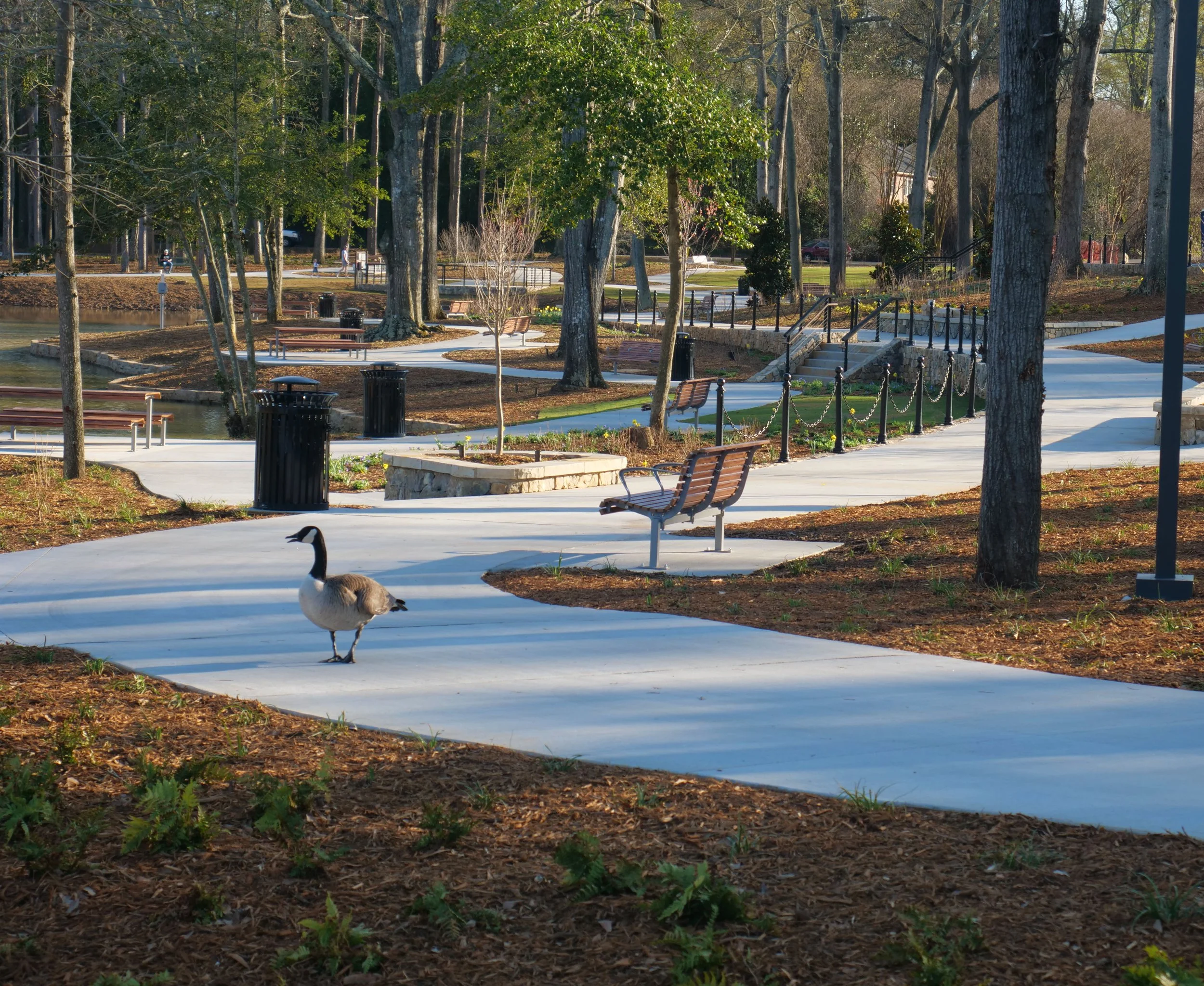
The new park features walking trails, benches, a wildlife habitat and more. (Photos: Deborah Wilson, The Anderson Observer)