Celebrating Special Families a Community Effort
Greg Wilson/Anderson Observer
On Saturday, the lights of the Civic Center will come up on something that looks, at first glance, like a familiar American ritual: round tables dressed in white, a buffet line, a DJ coaxing people onto the dance floor. Look closer, and the evening reveals itself as a kind of counternarrative to the isolation and exhaustion that so often define life with disability—a free public act of gratitude for the people who do the hardest work, and are least likely to be thanked for it. From 6-7:30 p.m., the 4th annual Celebrate Special Families Dinner & Dance will bring about 400 people—caregivers, parents, siblings, children, and friends—to the Anderson Civic Center on Martin Luther King Jr. Boulevard, for a night the organizers describe as “encouragement, gratitude, and joy.”
The story of the event begins far from Anderson, in a small, underserved part of India where a little girl was born to parents, Dr. Sanjeev Kumar and his wife Rashmi, who imagined for her what many parents imagine: opportunity, dignity, a life of open possibility. About 25 ago, they left that home and came to the United States in search of the version of that dream they had seen from afar. They ended up in Anderson, where they have lived for twenty-two years, raising their daughter—now twenty-six, with Down syndrome—in a town they say gave her “everything we could have hoped for… and more.”
It was not only the big American abstractions—freedom, opportunity—that mattered, but the quieter, local particulars: teachers who learned their daughter’s rhythms; neighbors who watched for her at the bus stop; church members, therapists, and bus drivers who folded her into the loose social fabric of the town. As the years went on, and their daughter moved from childhood toward adulthood, the couple learned what thousands of other families in similar situations know: that the work of supporting a person with special needs is relentless, intimate, and largely invisible. The world’s attention, when it comes, tends to rest on the child. The weight, so often, sits elsewhere.
They began to notice the constellation of people who made their daughter’s days possible: parents who built their schedules around therapy appointments; CNAs and nurses who learned to interpret gestures and moods; drivers who knew, without being told, when to linger an extra minute at the curb; caregivers whose names rarely made it into program booklets or church bulletins. The sacrifices, they realized, were cumulative and largely unseen—accrued in missed vacations, altered careers, and the slow, private nursing of a kind of fatigue that is more moral than physical. “Their sacrifices are often unseen, their efforts rarely celebrated,” they wrote later.
In 2023, deciding that the long, invisible work merited at least one visible act of thanks, the family—by then known in Anderson’s small world of disability services—used their own savings to rent a room, order food, and hire music. They called the evening Celebrate Special Families, and described it in plain terms: a free dinner and dance, focused not on the children but on the people who care for them. There would be food, music, and a bit of practical education, but mostly there would be permission—permission to dress up, to sit down, to be served instead of serving.
They assumed, at first, that it would be a one-time thing, a modest gesture of gratitude in a county where fundraisers and galas often compete for attention. About a hundred people came that first year—parents in their forties and fifties, grandparents, adult siblings, and care staff who, on most weekends, might have been working the night shift or catching up on sleep. As the evening unfolded, something unexpected happened. People lingered at their tables. Strangers compared notes on doctors and day programs. A nurse spotted a bus driver across the room and waved. County officials, circulating among the tables, watched as caregivers who were used to being background figures became, for a few hours, the main event.
The feedback came quickly and from multiple directions: from families who said that, in all their years of appointments and meetings, no one had ever organized a night simply to say thank you; from county leaders who saw, in the crowded room, a community that had never quite been invited to see itself; from service providers who urged the family not to stop.
“They encouraged us to continue, to grow it, and to make it an annual tradition,” said Dr. Kumar. Out of that encouragement came a formal structure: Celebrate Special Families (CSF), now a 501(c)(3) nonprofit that exists, on paper and in practice, to keep that one night alive and to widen its circle.
The numbers tell their own, slightly improbable story. The initial hundred attendees grew by the hundreds in subsequent years; for Saturday, the organizers are planning for roughly 400 people to walk through the Civic Center doors, making their way past registration tables and into a room configured not as a conference hall but as something closer to a wedding reception. The event, still free, is framed as “a night to celebrate families and honor caregivers—sharing encouragement, gratitude, and joy for all they give to others,” and the language reflects a shift in perspective: caregivers as protagonists rather than supporting cast.
The evening begins at six, early enough that families can arrive before bedtime routines. The event runs only until 7:30—long enough to feel like an occasion but short enough that those who must wake early for care responsibilities can still keep their routines.
People arrive in their Saturday best: pressed shirts, carefully chosen dresses, church shoes brought out again. Volunteers shepherd guests to tables. A blessing or a welcome is offered, and plates begin to fill. Between courses, there may be brief remarks—stories from families, acknowledgments of the nurses and aides whose work sustains the system. At some point, the music rises and the formalities recede. A caregiver, usually reserved, might be pulled into a line dance. A parent who has spent years managing crises might allow herself the small, radical act of laughing in public, with people who understand why that laughter is hard-won.
A Food Truck
But the event is no longer just a once-a-year respite. As the organizers kept listening to the people who showed up at those tables, a different kind of worry floated to the surface: what happens to adults with special needs after the school buses stop coming? Over and over, families described the same predicament. Their adult children wanted to work, and often could work, but the jobs that existed—if they existed—were narrow, temporary, or segregated. “Despite their abilities, willingness, and potential, they are often left out of the workforce,” the organizers observed.
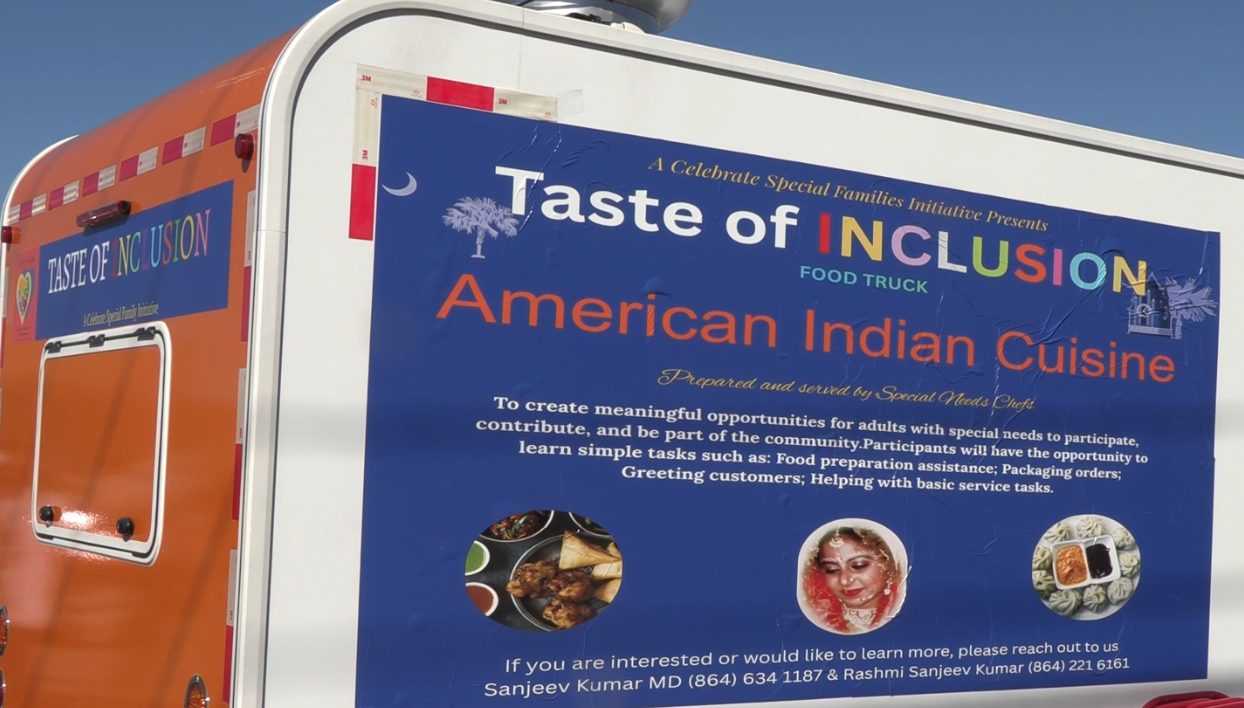
The response, like the original dinner, was small and specific: “Taste of Inclusion,” a project under the Celebrate Special Families umbrella, designed to create employment for youth and adults with special needs. The idea was straightforward, almost deceptively so. Indo–American food, prepared and served by families and individuals with disabilities, presented not as charity but as commerce—a food truck, a catering table, a presence at the mall. Customers would buy a meal; workers with special needs would earn a paycheck; the community would, ideally, recalibrate its sense of who belongs behind the counter.
Last week, Taste of Inclusion food truck has appeared in the parking lot of the Anderson Mall, selling Indo–American flavors “prepared and served by special needs families,” as one community post put it, and promoting itself with the quiet subversiveness of normalized inclusion: every meal supports, and is served by, the people the broader economy tends to pass by. Organizers said the impact has been “profound,” not only in the number of hours worked or meals sold but in the less quantifiable returns—dignity restored, confidence visible in the way someone stands a little straighter behind a register, purpose felt in the moment a customer offers thanks for good food rather than sympathy for a visible disability.
At its core, Celebrate Special Families remains what it was on that first, tentative night: a family’s attempt to repay a town that embraced their daughter by turning outward, toward the people whose labor allowed that embrace to be sustained. The language they use—“recognizing the unseen efforts, celebrating the quiet strength”—is plain, almost old-fashioned, and it sits a little apart from the technocratic vocabulary of social services and grant proposals. The work is similarly unadorned. Rent a hall. Set out tables. Make room, once a year, for the caregivers to sit down. Spend the rest of the year trying to move the needle, however slightly, on employment and belonging.
On Saturday, the Civic Center will once again function as a kind of temporary commons for a community that rarely sees itself reflected back in so flattering a light. The people who arrive that evening will bring, along with their dress shoes and their fatigue, stories that usually unfold in private: late-night medication schedules, years of paperwork, the intricate, improvised choreography of daily life with disability. For 90 minutes, they will be invited to imagine themselves not as a problem to be solved but as the occasion for celebration. In the scheme of things—a vast, underfunded care economy, a country struggling with how to value caregiving—it is a small gesture. In the life of a town, and in the memory of a family that crossed an ocean in search of possibility, it is also something else: proof that gratitude, when institutionalized, can look a lot like belonging.